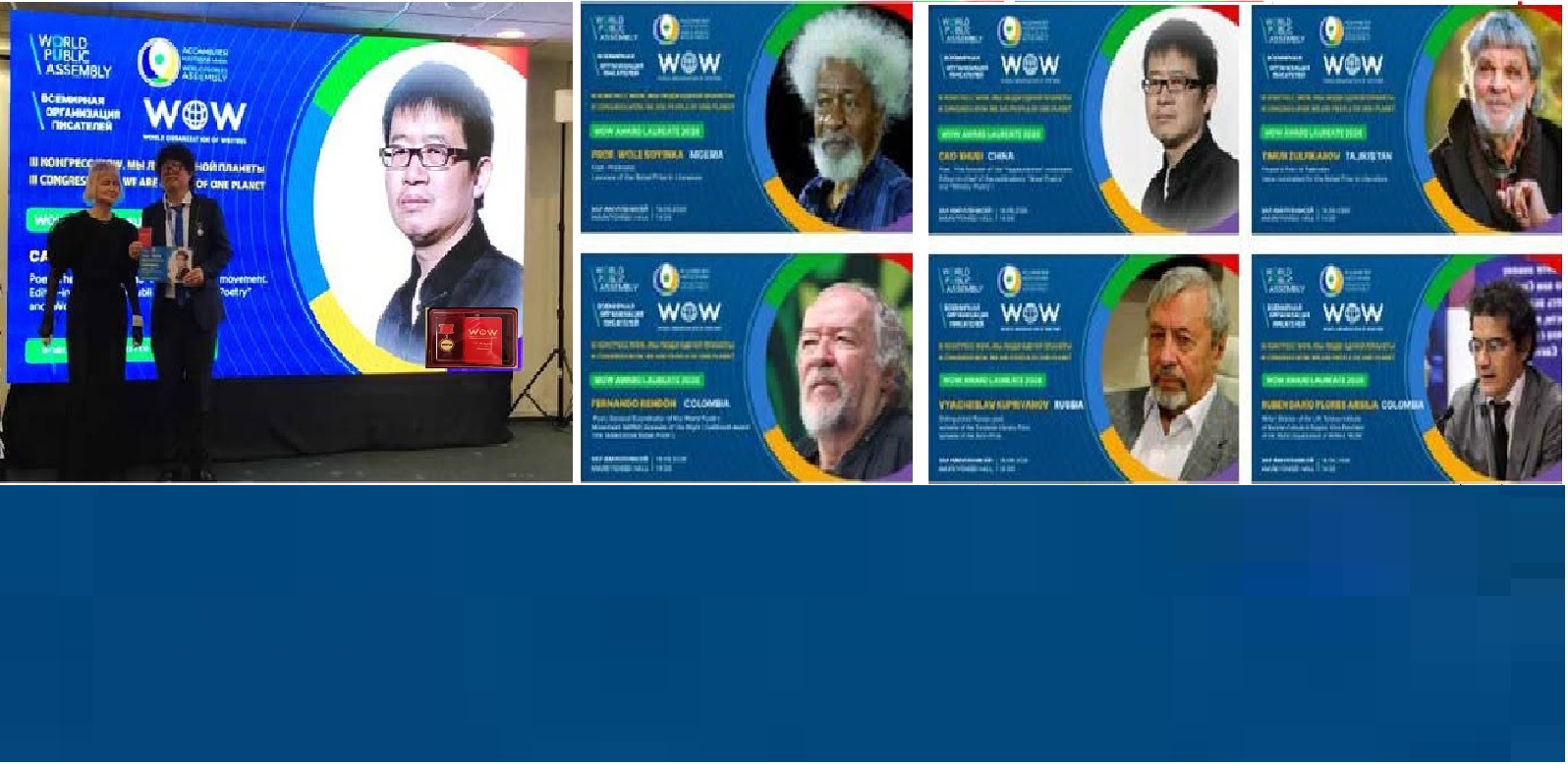
In Moscow, within the framework of the III Congress of the World Writers’ Organization (WOW), the WOW 2026 Award was presented. Among the laureates are outstanding literary figures from different parts of the world, and Cao Shui holds a special place among them: a poet, translator, and literary thinker.
The WOW Award, established by the LIFFT Foundation, the Assembly of the Peoples of the World, and the Pan‑African Writers’ Association (PAWA), honours authors whose work conveys universal spiritual and moral values and promotes the dialogue of cultures. In 2026, the award highlighted the idea that literature is both an art form and a means of humanitarian diplomacy capable of connecting civilisations.
Margarita Al, President of the World Writers’ Organization, delivered a speech when presenting Cao Shui with the WOW Gold Medal. Her words combined respect for literary tradition and an understanding of its contemporary mission:
“The name of this poet burst unexpectedly and swiftly into the global literary space — Cao Shui from China. His Epic of Eurasia, compared to numerous publications in this genre, stands out for its elevated style and academic depth. It is especially valuable that the author himself is a worthy embodiment of the image of a poet and a vivid illustration of a new ethics of creativity.
Cao Shui is not only the author of large‑scale poetic works: his essays form a holistic picture of his worldview. In his works, the scale of the epic conception does not get lost in the details; rather, it is through the artistic fabric that he reveals the depth of cultural codes without simplifying them. His method combines poetic imagery with precise wording: where a word should sound like a hymn, it does; where sober analysis is required, he does not hide behind a metaphor.
Cao Shui does not limit himself to personal creativity. He is the founder of the Hyperpoetry movement and the editor‑in‑chief of the publications Great Poetry and Weekly Poetry. Through these projects, he consistently builds a space where poetry becomes a form of public dialogue.
This is particularly close to our mission at WOW: to support forms of creativity that strengthen humanitarian security and preserve spiritual values for future generations. Cao Shui does exactly this: he affirms literature as a tool for peace and mutual understanding.
Today, we present him with the WOW Award for Epic of Eurasia, for his poetry, and for his editorial and organisational work — for the mission he carries out as a cultural architect. His activity is an example of how literature can be both art and action.
Thank you, Cao Shui, for not allowing the word to remain confined within a single culture. You have shown that great poetry is always a dialogue. And it is precisely this dialogue that the world needs today.”
Cao Shui’s Epic of Eurasia is a work of a special kind. It combines poetic expression with reflective thought, while the epic scope is supported by the documentary precision of its images.
It echoes ancient Chinese legends, biblical stories, ancient myths, Turkic tales, and Russian bylinas — not as quotations, but as living voices entering into dialogue. Cao Shui avoids superficial eclecticism: he seeks common archetypes, those points where different cultures speak about the same things — about the meaning of the journey, the cost of choice, and the connection between generations.
In addition to the Epic of Eurasia, Cao Shui writes essays in which he explores the formation of civilisations, the boundaries of language, and the possibilities of the poetic word. For him, poetry is a way to capture a moment and elevate it to a symbol, while reflection allows one to trace how that symbol lives through time, acquiring history and memory.
That is why Cao Shui’s work has attracted international attention: his works are translated into many languages, discussed at conferences, and used as material for intercultural studies. For many readers, they serve as a cultural compass.
The Hyperpoetry movement, initiated by Cao Shui, sets a new framework for poetic expression: it combines the scale of epic narrative with the intensity of modern language. Through the publications Great Poetry and Weekly Poetry, Cao Shui creates a platform where authors with different traditions and approaches can meet, while maintaining high standards for artistic quality and the ethical responsibility of the word.
This is a consistent cultural strategy: not to reduce diversity to a single standard, but to give every voice the opportunity to be heard and understood.
Cao Shui’s philosophy is based on the belief that literature is one of the most reliable ways to understand each other. In a world where political and economic interests often drive people apart, culture can become a neutral territory where different views meet and find common ground.
He does not seek to impose a single value system but creates a space where different traditions can coexist and enrich each other. His translations, essays, and poetic texts are always an invitation to dialogue: to listen, to understand, to respond.
Presenting the WOW Award to Cao Shui is a recognition of both his poetic talent and his cultural mission. In the 2026 list of laureates, he stands alongside authors from Tajikistan, Russia, Colombia, and Nigeria — and this, too, has meaning: the award does not highlight isolated stars but a constellation of voices that together shape a new literary landscape.
The First WOW Congress in Abuja showed that African literature can be a point of attraction for the global community. Now, with Moscow hosting the Third Congress, it emphasises that literary dialogue is a process in which every voice matters, regardless of language or geography.
Cao Shui — a Chinese poet, translator, and literary thinker. Founder of the Hyperpoetry movement. Editor‑in‑chief of Great Poetry and Weekly Poetry publications. Author of Epic of Eurasia, poetry collections, essays, and literary studies. His works have been translated into many languages. He actively participates in international cultural projects, promoting the idea of literature as a tool for peace and mutual understanding. Laureate of the WOW 2026 Award and the Gold Medal for works that exemplify the highest ethics of creativity.